
2nd European Cross-Border Power Trading &
Grid Balancing Market 2026
17 - 18 September 2026 | Berlin
2nd European Cross-Border Power Trading & Grid Balancing Market 2026
The 2nd European Cross-Border Power Trading & Grid Balancing Market 2026 is Europe’s leading forum dedicated to the future of cross-border electricity trading, balancing markets, and grid stability. As electrification accelerates and renewable penetration increases, Europe’s interconnected power system faces rising volatility, congestion, and operational complexity—making cross-border coordination more critical than ever.This conference brings together TSOs, power exchanges, utilities, traders, regulators, and technology providers to explore evolving market design, congestion management, and balancing mechanisms across Europe. Key discussions focus on CACM 2.0 reforms, harmonised balancing products, battery energy storage (BESS), digital twins, AI-driven dispatch, hydrogen–power market coupling, and weather-driven risk management.Through expert panels, technical deep dives, and real-world case studies, attendees will gain practical insights into cross-border congestion relief, intraday and balancing optimisation, offshore wind integration, and new business models enabled by flexibility, storage, and digitalisation. This conference is essential for professionals shaping Europe’s integrated, resilient, and future-ready electricity markets.
Why Attend Conferences Hosted by Us?
PEER TO PEER
We make sure that you are in good company. Prospero conferences provide energy industry experts and decision-makers a platform to discuss common challenges, share best practices, and network.
LONGEST INTERACTION TIME
We promise the most prolonged average duration of direct peer-to-peer networking (at least 10 minutes per participant within two days of an in-person event) with the most senior and relevant professionals about specific energy-themed topics.
ENERGY SECTOR
Since 2013, we have been specializing in producing conferences in the energy sector. Our in-depth knowledge of the industry helps us create tailor-made conferences on the latest and the most pressing developments.
EUROPE
Europe is at the forefront of advancements and revolutions in the clean energy transition. We aim to provide a platform for European decision-makers in the energy industry to benchmark best-practices with their peers.
Speakers
Per Kamperin
Senior Advisor-Market Design
SVENSKA KRAFTNÄT
(SWEDISH POWER GRID)

Parameeta Brahma
E.ON Energy Markets - Tech PM |
Energy Trading Forecasting Data Science
E.ON

Lars Weber
Partner, Business Development
YGGDRASIL

Krishna Solberg
Senior advisor
STATNETT SF

Roman Hennig
Systems & Markets
Policy & Process Advisor
TENNET

Rafael Gomez Elvira Gonzalez
Director of Public
Affairs and Marketing
OMIE

Vincent Thevenin
Market Expert
MONTEL
Mario Dell'Era
Senior Quantitative Market
Risk Manager
ENBW

Vija Pakalkait
Interim Group Lead
European Cooperations
50HERTZ

Hubert Put
Senior Consultant
MONTEL

Bhanu Duggal
Senior Analyst - Market
Analysis
EDF (UK)

Karol Nicia
Senior Market Development Manager - Intraday, Market Integration Team
NORD POOL

Adrien Touwaide
Consultant
ELIA GRID INTERNATIONAL (EGI)
* preliminary confirmed
Speakers Introduction
Testimonials
"Thank you very much. It was also my pleasure to participate and I’m looking forward to our next
project"National Information Security Officer, Vattenfall

"Great organization! I really enjoyed the international character: so many different participants from different countries and perspectives and all that was very valuable."VP Infrastructure Economics, E.ON

"I find all the presentations very relevant to the challenges we are going to deal with. It is good to understand the trends as well as hear the experience from other colleagues on how they are approaching those challenges"GM & CEO, CEZ

"Thank you very much for the opportunity to speak. It was great working with you and the pleasure was mine as well to get to know you. I’m also interested in further collaborations. It’s a good thing that you got going here. Unfortunately, this time I was not able to participate full time, I hope next time this will be possible again."Head of SAS Engineering, Swissgrid
Register Now
Seats are filling up fast. Book your attendance today!
IN-PERSON DELEGATE
1499€
Access to the 2-day conference in-person at the venue
Peer-to-peer networking between sessions
Post-conference Documentation Package
Refreshments, coffee breaks, and luncheons at the hotel venue
VIRTUAL DELEGATE
599€
Access to the 2-day conference online
Post-conference Documentation Package
Media Partner
Energy Tech Review Europe is a leading print and digital publication serving professionals across the energy ecosystem, including power generation, renewable energy, energy storage, grid infrastructure and emerging energy technologies. Reaching a broad audience of industry professionals across Europe and the UK, the magazine provides practical industry insights, technology developments, leadership perspectives and market trends to energy executives and decision-makers.Its editorial coverage spans key areas such as smart grids, renewable energy, energy storage, hydrogen, digital energy, grid resilience, asset management and energy transition technologies. Through expert interviews, industry features, technology analysis and thought-leadership content, Energy Tech Review helps its readers stay informed about the latest developments shaping the future of the energy sector.The publication also provides a platform for technology providers, utilities, energy companies and industry experts to share innovative solutions, operational experiences and strategic perspectives. Its strong focus on digitalisation, sustainability, infrastructure modernisation and emerging technologies makes it particularly relevant to professionals navigating the rapidly changing European energy landscape.As a Media Partner, Energy Tech Review supports greater industry awareness, knowledge exchange and engagement by connecting our event with a wider community of energy professionals, technology leaders and senior decision-makers across Europe.
Speaking, Branding, and Sponsorship Opportunities

Ignite unprecedented business growth by seizing the extraordinary opportunity to sponsor the event. Leverage Speaking, Branding, and Sponsorship Opportunities to showcase your expertise, elevate your brand visibility, and forge enduring connections with decision-makers and qualified buyers who align seamlessly with your target market.Our Speaking, Branding, and Sponsorship Opportunities platform is not just an investment; it's a strategic partnership designed to maximize your value. Whether you're looking to turbocharge your advertising, drive impactful business development, amplify your promotional strategies, or optimize your overall marketing investments, rest assured that we possess the expertise to elevate your brand and deliver exceptional conversions.Seize this opportunity now to secure Speaking, Branding, and Sponsorship Opportunities beyond traditional marketing. Join us at the forefront of industry influence, let your voice be heard on stage, your brand shine across channels, and your message resonate with a curated audience of decision-makers.
Who Should Attend?
Industry Focus
Transmission System Operators (TSOs)
Electricity Market Exchanges & Platforms
Independent Power Producers (IPPs)
Energy Trading Companies
Balancing Service Providers (BSPs)
Power Utilities & Retailers
Cross-border Interconnector Developers/Operators
Regulatory Bodies & National Energy Authorities
Energy Market Design & Consulting Firms
Software & Digital Platforms for Market Optimization
Grid Optimization & Forecasting Technology Providers
Renewable Energy Aggregators
Energy Storage Operators (for balancing services)
Clearing & Settlement Providers in Power Markets
Energy Data & Analytics Companies
Job Titles
Head of Cross-Border Trading
Director of Power Market Operations
Head of Market Coupling & Integration
Senior Electricity Trader
Balancing Services Manager
Head of Grid Operations
Regulatory Affairs Director – Power Markets
Head of Interconnectors & Transmission Access
Real-Time Trading Manager
Senior Analyst – Electricity Market Design & Forecasting
Head of Energy Market Strategy
Director of Interconnected Grid Services
Congestion Management Lead
Policy Advisor – Energy Market Regulation
Market Access & Compliance Specialist
Venue
NH Collection Berlin Mitte am Checkpoint Charlie
𝐕𝐞𝐧𝐮𝐞
NH Collection Berlin Mitte am Checkpoint Charlie
Address: Leipziger Str. 106-111, 10117 Berlin, Germany
𝐑𝐞𝐬𝐞𝐫𝐯𝐚𝐭𝐢𝐨𝐧 𝐈𝐧𝐟𝐨𝐫𝐦𝐚𝐭𝐢𝐨𝐧:
To book your accommodation for the event, get in touch with the NH Collection Berlin Mitte am Checkpoint Charlie's reservation department:
𝐏𝐡𝐨𝐧𝐞: +49 30 203 76 300
𝐄𝐦𝐚𝐢𝐥: [email protected]
When booking, please mention 𝐏𝐑𝐎𝐒𝐏𝐄𝐑𝐎 to ensure you receive the appropriate rates and accommodations for the event.

Past Participants


POST CONFERENCE DOCUMENT199€
✓ Speaker Topic Presentation Documents
Speaking, Branding, and Sponsorship Opportunities


At Prospero Events Group, we prioritize Speaking, Branding, and Sponsorship Opportunities as powerful avenues to foster meaningful connections and active engagements that drive your business forward.
We provide an exclusive platform for industry leaders to showcase their expertise, amplify their brand, and engage with decision-makers through high-impact speaking slots, branded materials, and tailored sponsorship packages. These opportunities position your organization at the forefront of industry innovation, ensuring your solutions and thought leadership reach a highly targeted audience.Our conferences are designed to create a dynamic environment where sponsors can deliver their message directly to key executives actively seeking partnerships and innovative ideas. With options to exhibit your brand, present on stage, and maximize your visibility through premium branding opportunities, you’ll make a lasting impression on top-level delegates.Partner with Prospero Events Group to leverage these Speaking, Branding, and Sponsorship Opportunities, elevate your profile, and forge powerful connections that set your business apart in today’s competitive landscape.

Platinum Sponsor

1 Speaking slot.
3 in-person passes for the 2-day event (speaker included in these passes).
Booth space provided with a desk and two chairs. Roll-up banner (provided by sponsor) placed in the venue.
Participation in the panel discussion.
Logo with hyperlink featured on the event website.
Social media promotion, including dedicated pre-event posts.
Logo featured on the event agenda and highlighted in pre-event email campaigns sent to potential attendees.
Sponsor’s business description and contact information included in the final agenda.
Access to participants' contact details.
Gold Sponsor

1 Speaking slot.
2 in-person passes for the 2-day event (speaker included in these passes).
Booth space provided with a desk and two chairs. Roll-up banner (provided by sponsor) placed in the venue.
Participation in the panel discussion.
Logo with hyperlink featured on the event website.
Social media promotion, including dedicated pre-event posts.
Logo featured on the event agenda and highlighted in pre-event email campaigns sent to potential attendees.
Sponsor’s business description and contact information included in the final agenda.
Access to participants' contact details.
Silver Sponsor

1 Speaking slot.
1 in-person pass for the 2-day event (speaker included in this pass).
Booth space provided with a desk and two chairs. Roll-up banner (provided by sponsor) placed in the venue.
Participation in the panel discussion.
Logo with hyperlink featured on the event website.
Social media promotion, including dedicated pre-event posts.
Logo featured on the event agenda and highlighted in pre-event email campaigns sent to potential attendees.
Sponsor’s business description and contact information included in the final agenda.
Access to participants’ contact details.
Speaking Slot

1 Speaking slot: 45 min: 30 min session and 15 min Q&A
1 in-person pass for the 2-day event (speaker included in this pass).
Participation in the panel discussion
Social media promotion leading up to the conference
Access to participants' contact details
Post-conference Documentation Package
Submit Your Interest
Thank you! 😊
Our team will respond within 24-48 hours.
Online Payment
IN-PERSON DELEGATE
1499€
VIRTUAL DELEGAT
599€
Blog
Balancing Markets 2026: aFRR, mFRR, and the New Normal
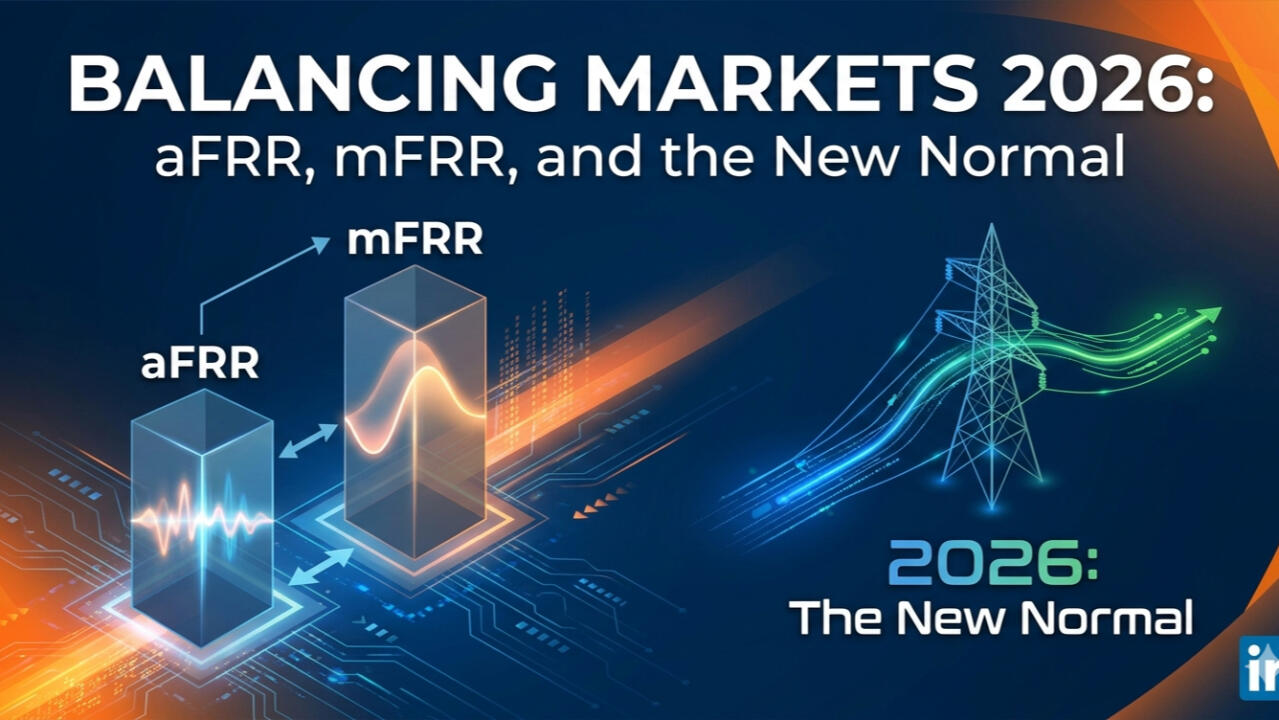
The European balancing landscape has quietly undergone one of its most consequential transformations in decades. With the full-scale rollout of cross-border platforms for automatic and manual frequency restoration reserves, the rules of the game have changed—not incrementally, but structurally.
Grid Is the Real Bottleneck in Energy Transition
For years, the biggest challenge in the energy transition was building enough renewable energy capacity. Today, that problem is rapidly disappearing. Solar and wind are now the cheapest sources of electricity in many regions, and investment in renewable projects continues to accelerate.
Congestion Management Playbook: Redispatch → Countertrading
When power grids “bind,” markets don’t fail, operators intervene. Behind the scenes, system operators deploy a toolkit designed to keep markets whole while maintaining physical reliability. Two of the most critical levers: redispatch and countertrading.
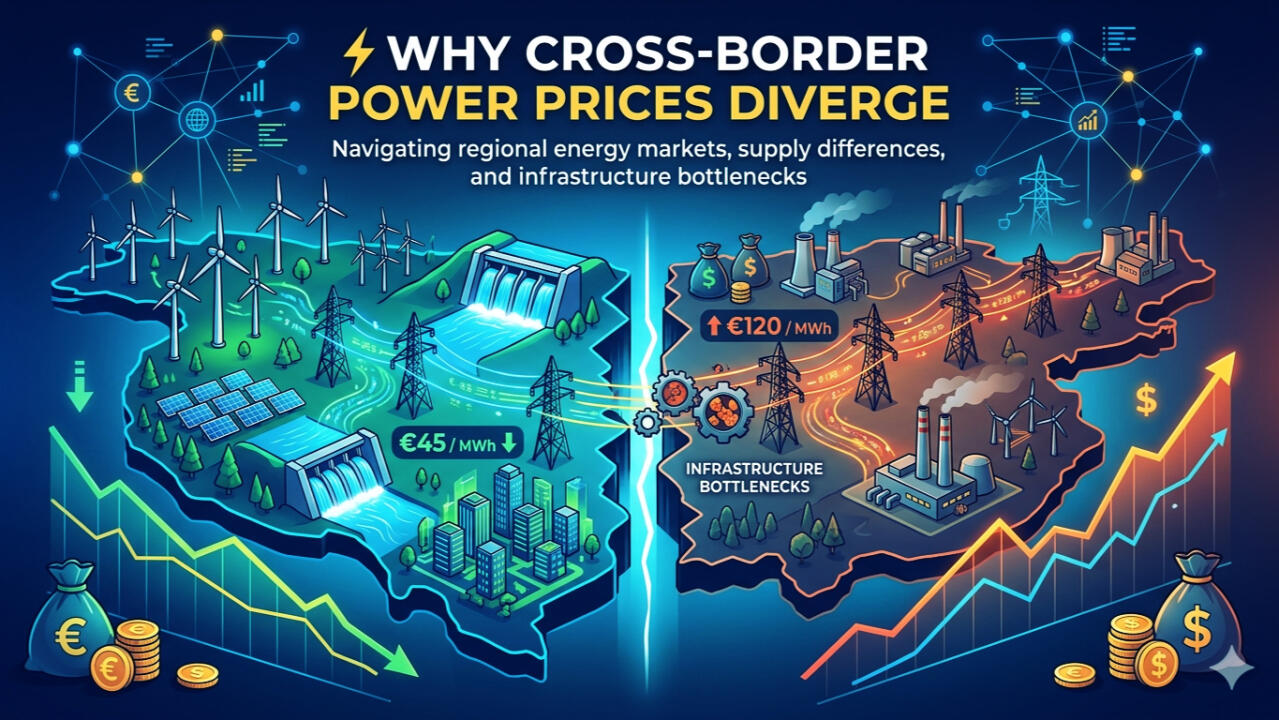
⚡ Why Cross-Border Power Prices Diverge
What price spreads really tell us about Europe’s power markets in 2026
Europe’s electricity market was designed for convergence. But in 2026, price divergence across borders is not the exception — it’s the signal. For traders, this isn’t inefficiency. It’s opportunity, if you understand what’s driving it.
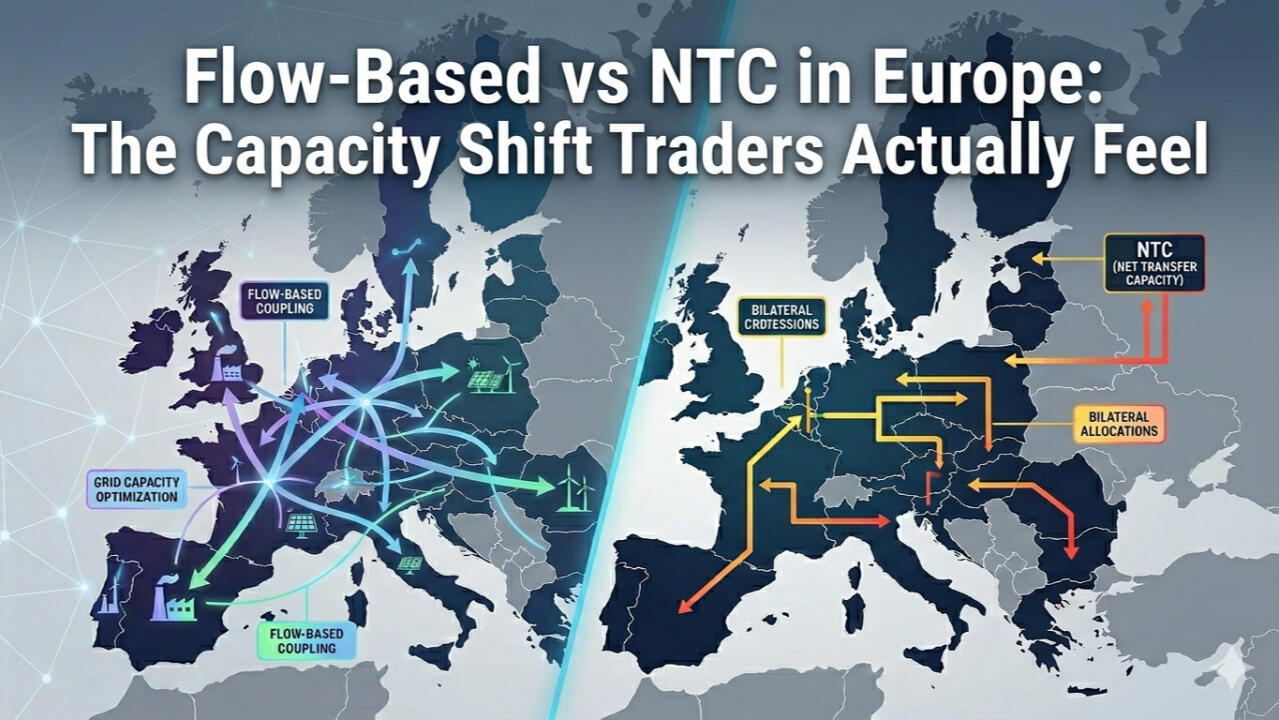
Flow-Based vs NTC in Europe: The Capacity Shift Traders Actually Feel
What changes when Europe’s power markets become network-aware and why it matters.
If you’re entering European power markets, you’ll quickly come across two key concepts: NTC (Net Transfer Capacity) and Flow-Based. They both answer the same fundamental question:
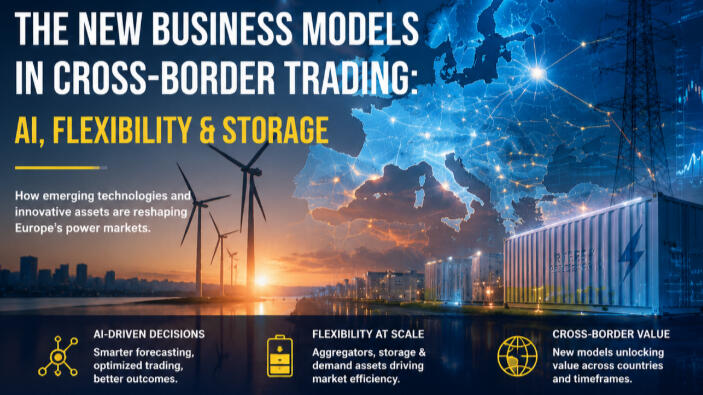
The New Business Models in Cross‑Border Trading: AI, Flexibility & Storage
Market Spotlight: Europe Faces Surging Winter Power Prices
Europe’s electricity markets are undergoing a transformative phase, driven by cross-border trading, AI-powered optimisation, and flexible storage assets.
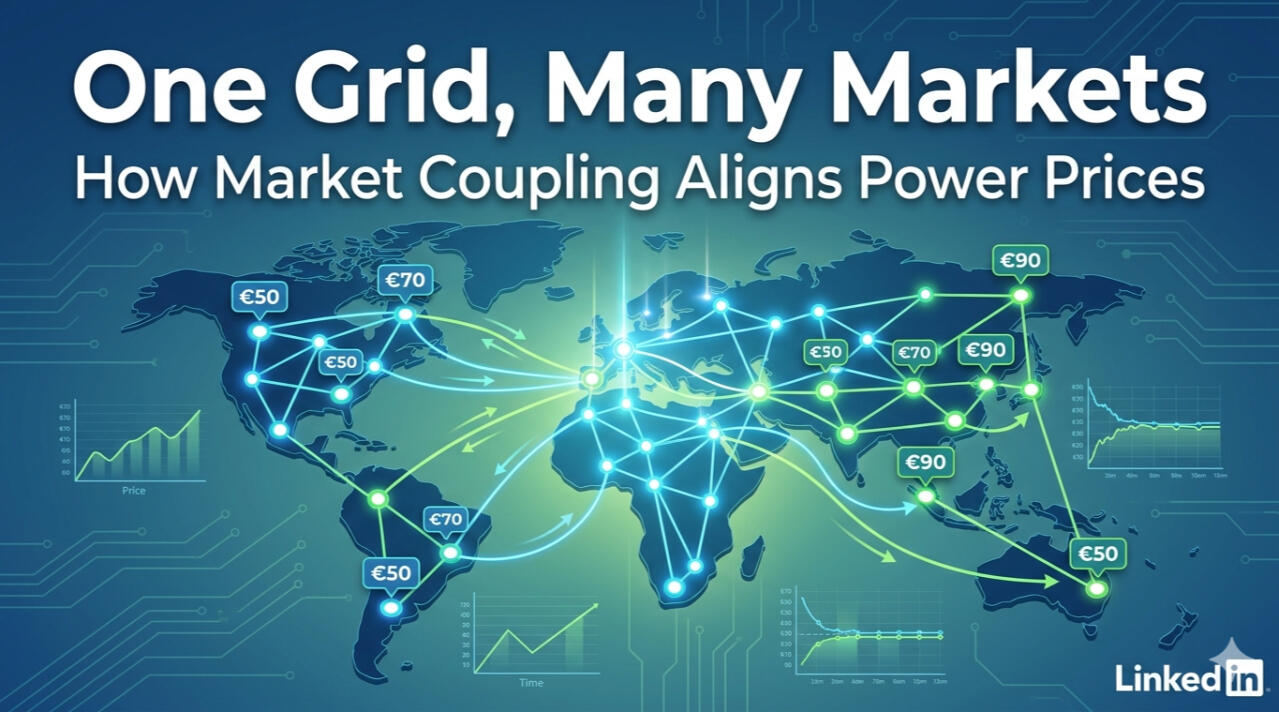
One Grid, Many Markets: How Market Coupling Aligns Power Prices
Why Do Power Prices Differ Across Borders?
Even in interconnected regions, electricity prices don’t always match. Why? Because without coordination:
One region may have surplus (low prices) Another may face shortage (high prices)And limited transmission prevents balancing
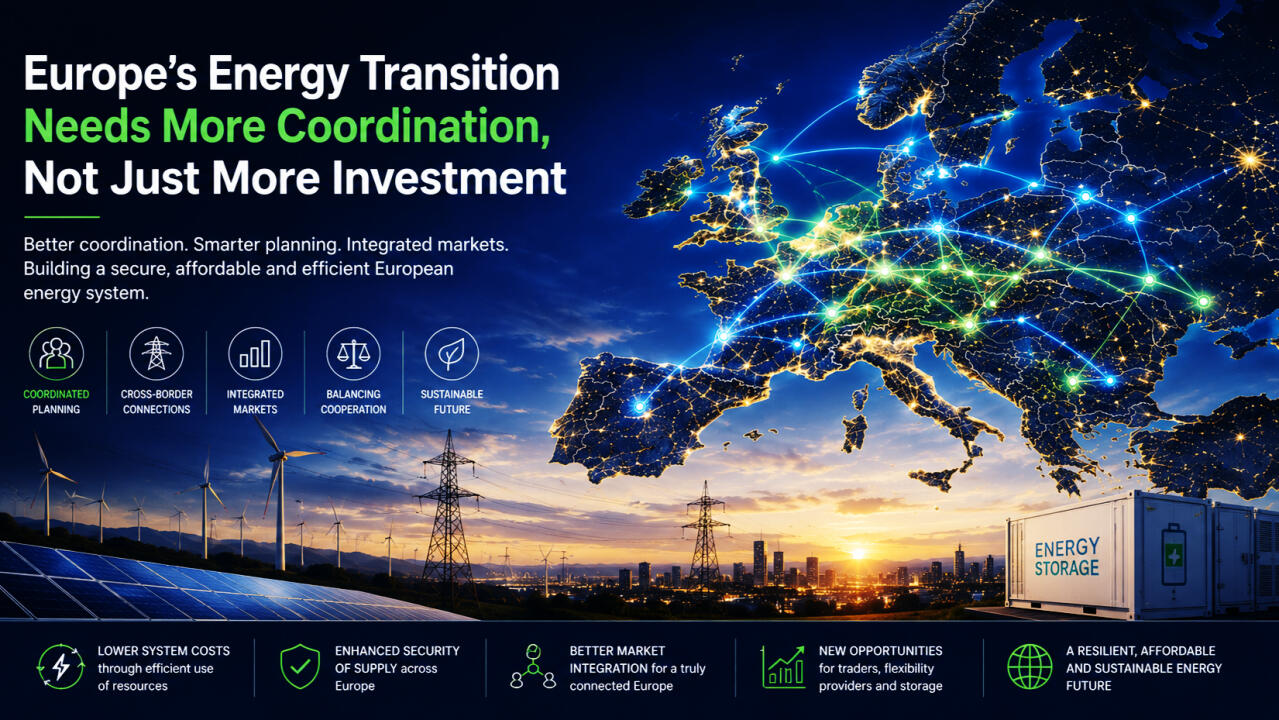
Europe’s Energy Transition Needs More Coordination, Not Just More Investment
As renewable generation expands, electrification accelerates, and cross-border power flows become increasingly important, fragmented planning across national markets is creating inefficiencies that drive up costs, slow infrastructure deployment, and limit the full value of market integration.
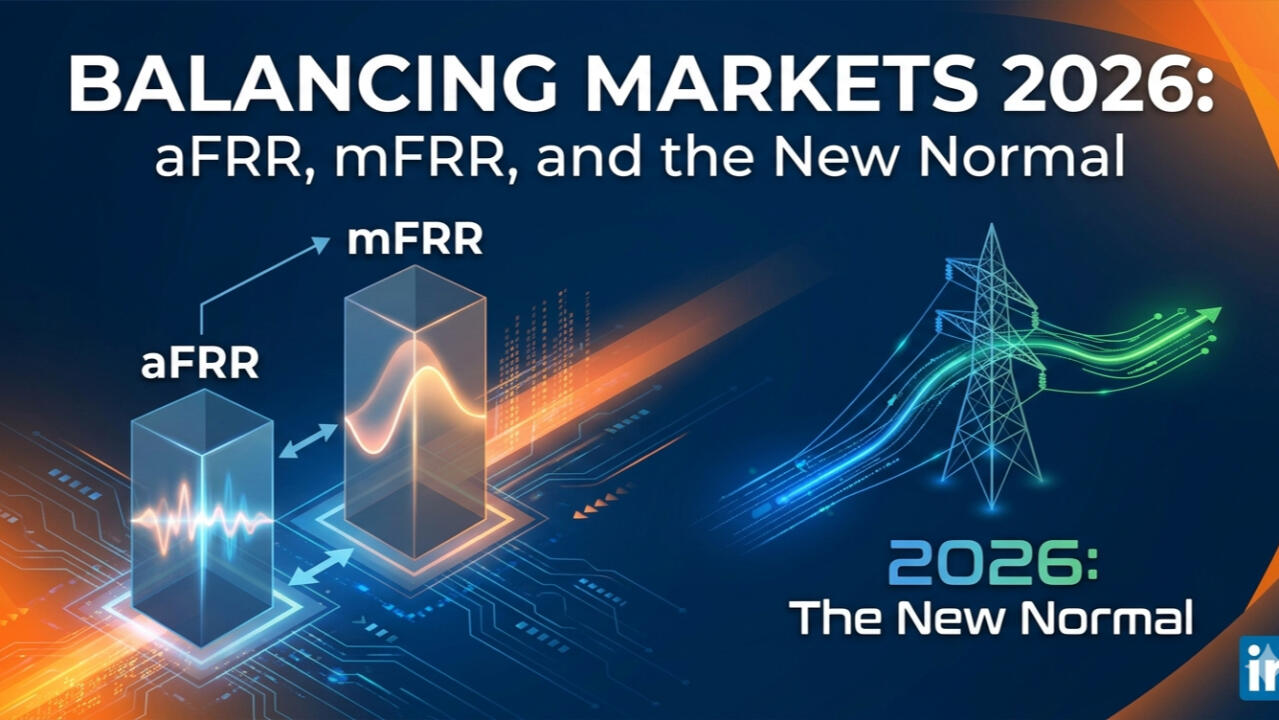
Balancing Markets 2026: aFRR, mFRR, and the New Normal
Balancing Markets 2026: aFRR, mFRR, and the New Normal
The European balancing landscape has quietly undergone one of its most consequential transformations in decades. With the full-scale rollout of cross-border platforms for automatic and manual frequency restoration reserves, the rules of the game have changed—not incrementally, but structurally.For utilities, traders, and flexibility providers, 2026 is not just another year. It marks the arrival of a new operating normal.From Fragmented to Federated: The Integration Shift
Historically, balancing markets were national, fragmented pools of flexibility with limited coordination. That model is now obsolete.
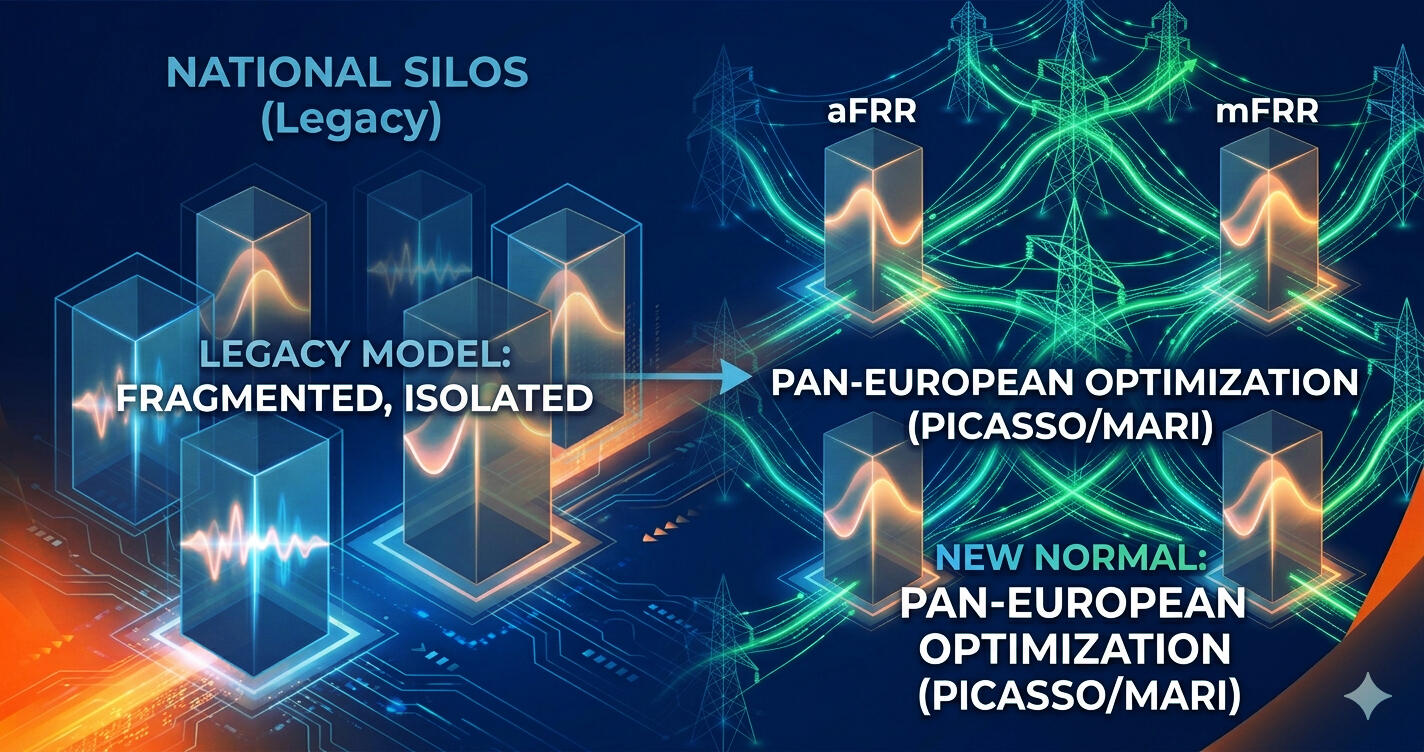
Today:The aFRR platform (PICASSO) and mFRR platform (MARI) enable pan-European optimization of balancing energy.
Most TSOs are now connected or in the process of joining, dramatically increasing liquidity and competition.
Cross-border capacity is increasingly allocated to balancing, not just day-ahead or intraday markets.This shift fulfills a core objective of European market design: shared balancing resources across borders to improve efficiency and reduce system costs.🎯 Want to stay ahead in the world of Cross-Border Power Trading & Grid Balancing?
🎯 Join us at the 2nd European Cross-Border Power Trading & Grid Balancing Market 2026 conference!
📍 September 17-18, 2026 | Berlin, Germany
💥 Register Now: DOWNLOAD EVENT AGENDA
aFRR vs mFRR: Faster, Smarter, More Competitive
Understanding the new dynamics requires revisiting the roles of aFRR and mFRR:aFRR (automatic): Activated within seconds to minutes, continuously correcting system imbalances. It operates in near real-time and is increasingly algorithm-driven.
mFRR (manual): Activated within ~15 minutes, used for sustained or larger imbalances, often through centralized optimization platforms.What’s changed is not the physics, but the market access and clearing logic:Both products are now traded across borders via common merit order lists.
Activation is increasingly driven by pan-European cost optimization, not local scarcity.Volatility: Dampened Peaks, Sharper Competition
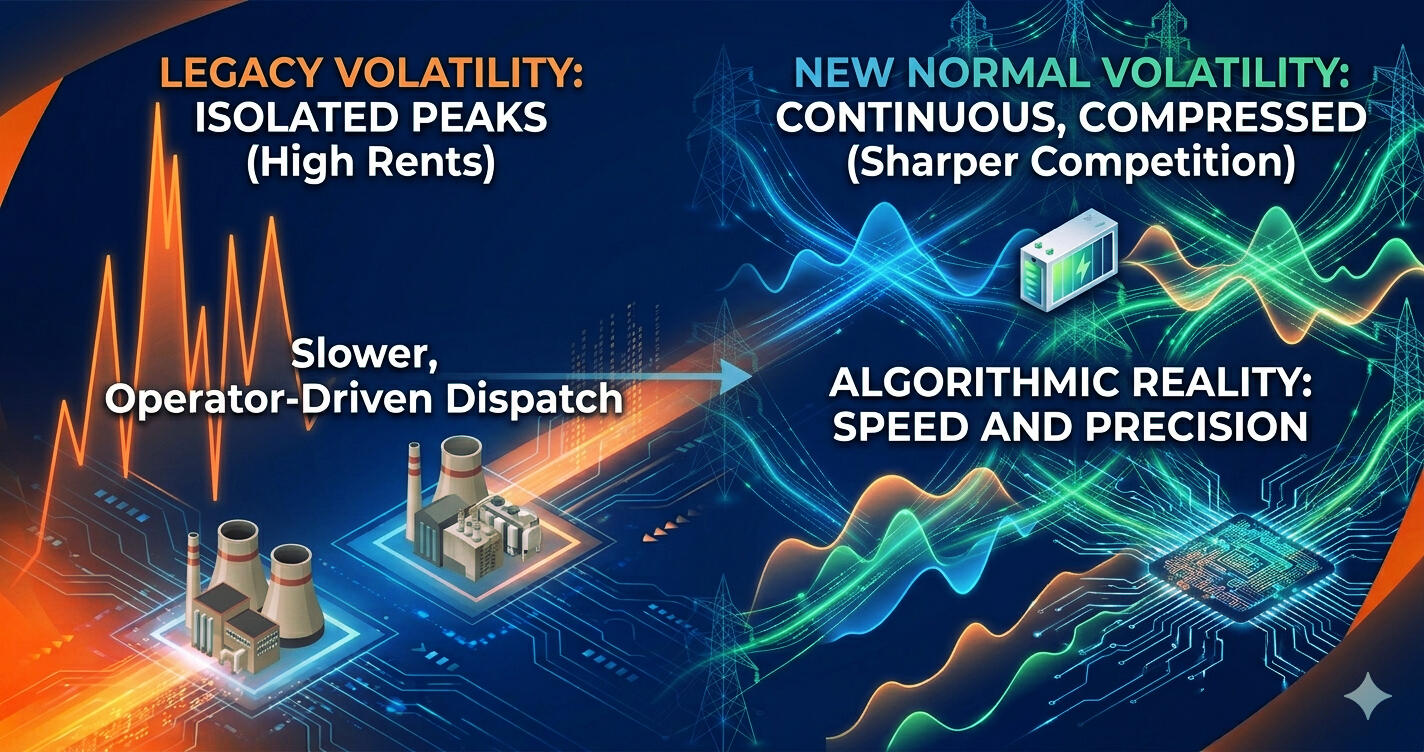
A key expectation from integration was reduced volatility, and that is partially true.Cross-border balancing has smoothed extreme price spikes, as cheaper flexibility from neighboring systems can now be activated.
Increased liquidity has compressed spreads, particularly in aFRR energy markets.But this comes with a twist:Volatility hasn’t disappeared, it has changed shape.
Price signals are now more continuous but less forgiving.
Margins are thinner; timing and forecasting errors are penalized faster.
Local scarcity events still occur, but are rarer and more unpredictable.Costs: Efficiency Gains… with Distributional Effects
From a system perspective, integration is working:TSOs can access lower-cost balancing bids across borders, improving overall efficiency.
Increased competition is pushing down average procurement costs.However, the distribution of value is shifting:Assets that relied on local scarcity rents (e.g., legacy thermal units) face margin erosion.
Fast, flexible technologies (especially batteries) benefit from high-frequency participation in aFRR.
Geographic advantage is declining as location-based premiums compress.In short: system costs go down, but not everyone wins equally.Dispatch & Operations: Algorithmic Reality
The biggest operational shift is in dispatch logic:Activation is now driven by centralized European algorithms, not local operator discretion.
Real-time price publication (e.g., mFRR) is increasing transparency—and competitive pressure.
Imbalance pricing is directly tied to marginal balancing activations across platforms.This creates a new operational paradigm:-Forecasting accuracy becomes a core competency
-Automation and algorithmic bidding are no longer optional
-Portfolio optimization must be cross-market (DA, ID, balancing)Final Thought
The integration of aFRR and mFRR markets is doing exactly what it was designed to do: create a single, efficient balancing system for Europe.But efficiency comes at a price—the disappearance of easy profits.In the new normal, value still exists. It’s just harder, faster, and more competitive to capture.
🎯 Join us at the 2nd European Cross-Border Power Trading & Grid Balancing Market 2026 conference!
📍 September 17-18, 2026 | Berlin, Germany
💥 Register Now: DOWNLOAD EVENT AGENDA
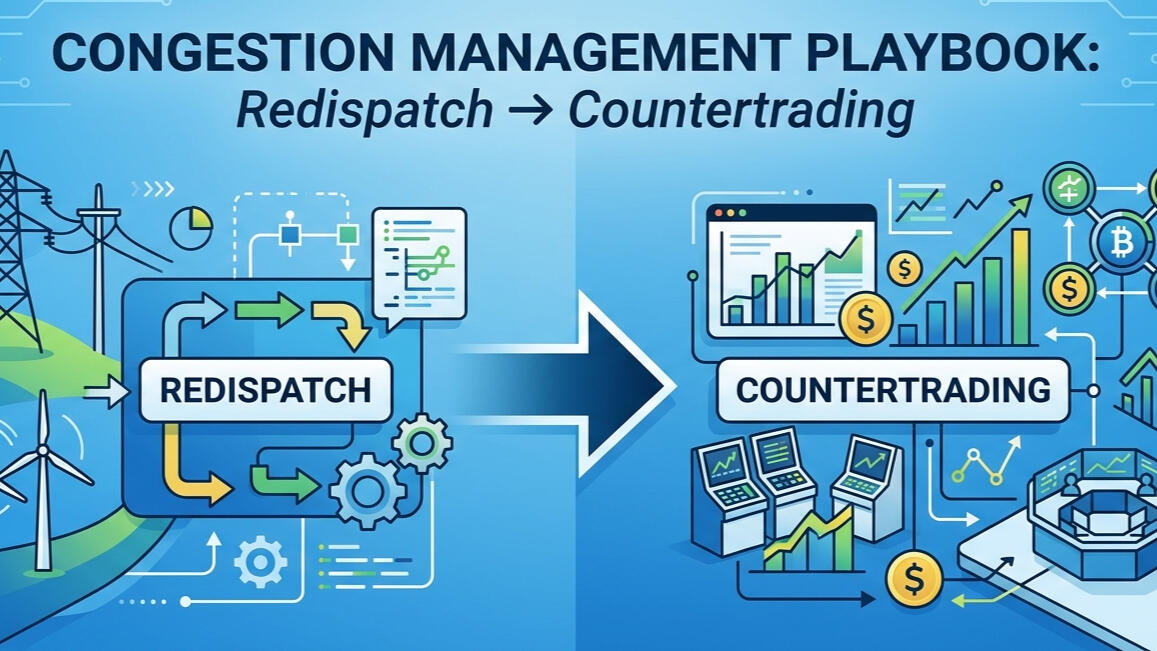
Congestion Management Playbook: Redispatch → Countertrading
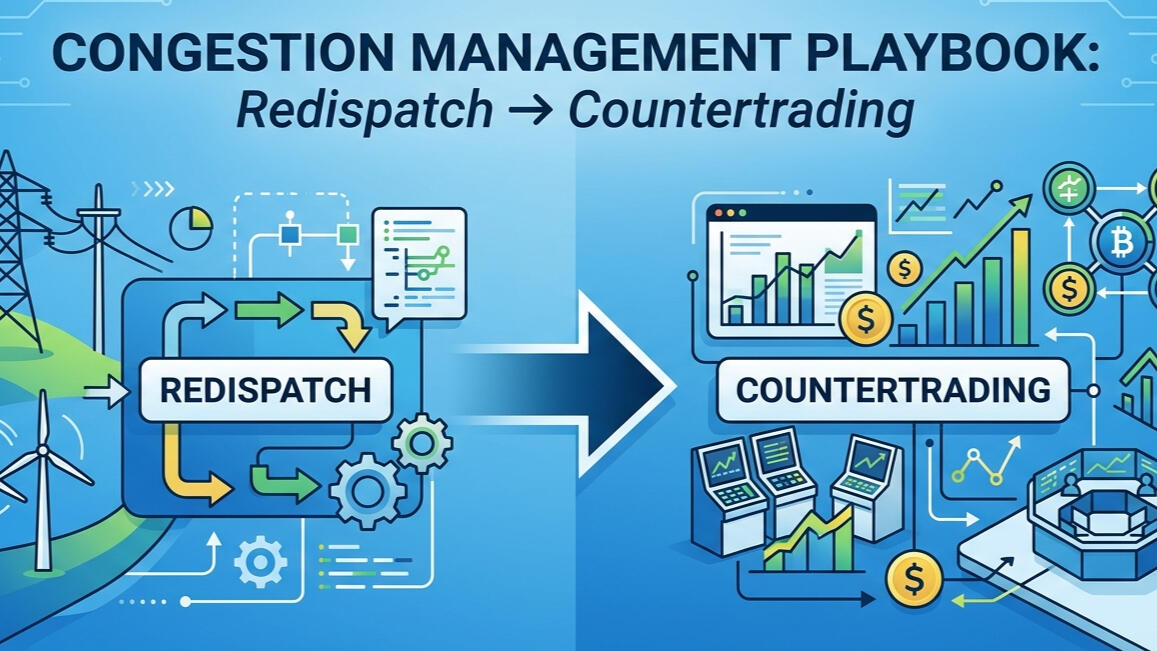
When power grids “bind,” markets don’t fail, operators intervene. Behind the scenes, system operators deploy a toolkit designed to keep markets whole while maintaining physical reliability. Two of the most critical levers: redispatch and countertrading.⚡ Why congestion happens
Electricity markets clear economically, not physically. Power flows obey physics, not contracts. When transmission constraints are hit (line limits, outages, loop flows), the system must be rebalanced in real time.Redispatch: Adjusting generation after the
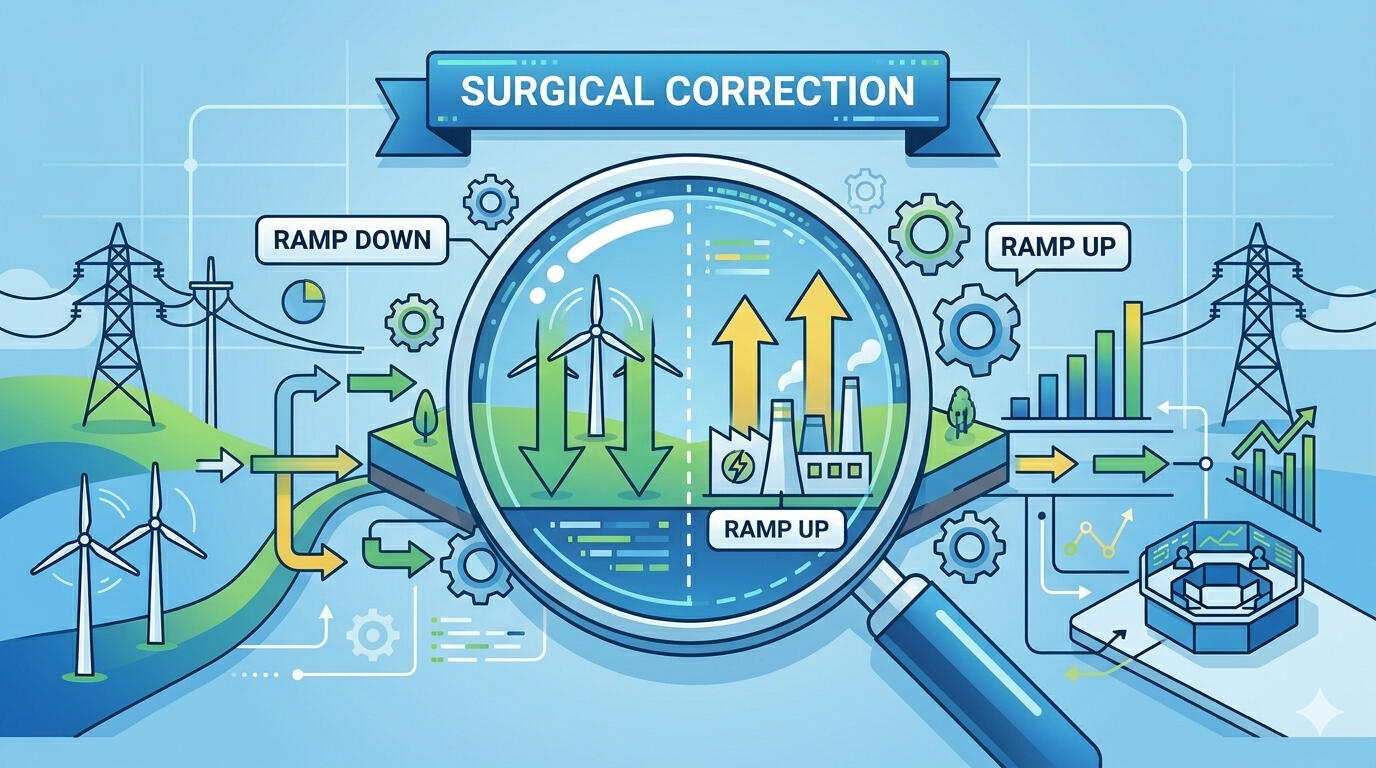
Redispatch is the process of instructing generators to increase or decrease output from their scheduled positions.Generators in constrained (overloaded) areas are asked to ramp down
Generators elsewhere are asked to ramp up
The goal: relieve network stress without re-running the entire market💡 Think of it as “surgical correction”, precise, targeted, and fast.Trade-offs: Costs can rise (out-of-merit dispatch), requires transparency and fair compensation mechanisms and can distort price signals if overused.
🎯 Join us at the 2nd European Cross-Border Power Trading & Grid Balancing Market 2026 conference!
📍 September 17-18, 2026 | Berlin, Germany
💥 Register Now: DOWNLOAD EVENT AGENDA
Countertrading: Cross-border balancing
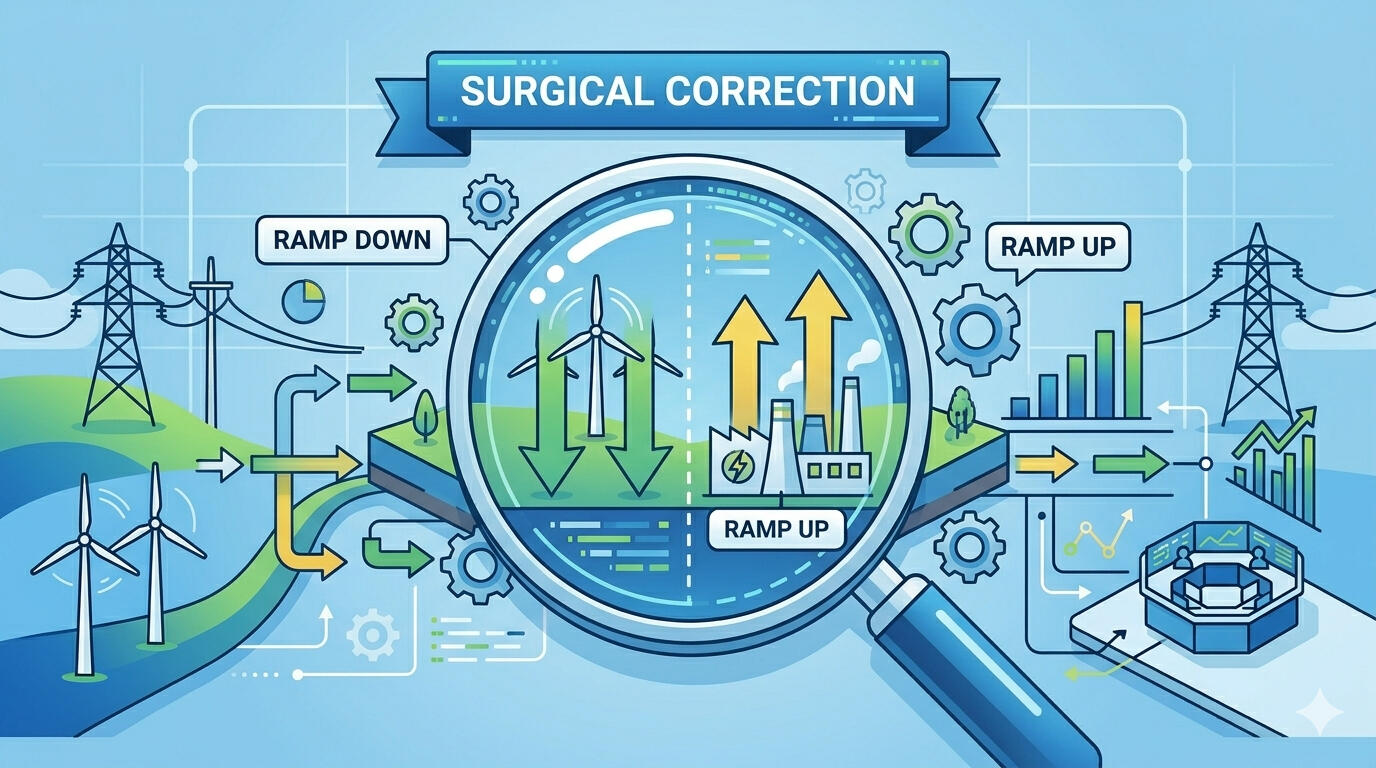
Countertrading extends the idea across bidding zones or countries.System operators buy and sell energy in different locations to relieve congestion
Often used in interconnected markets
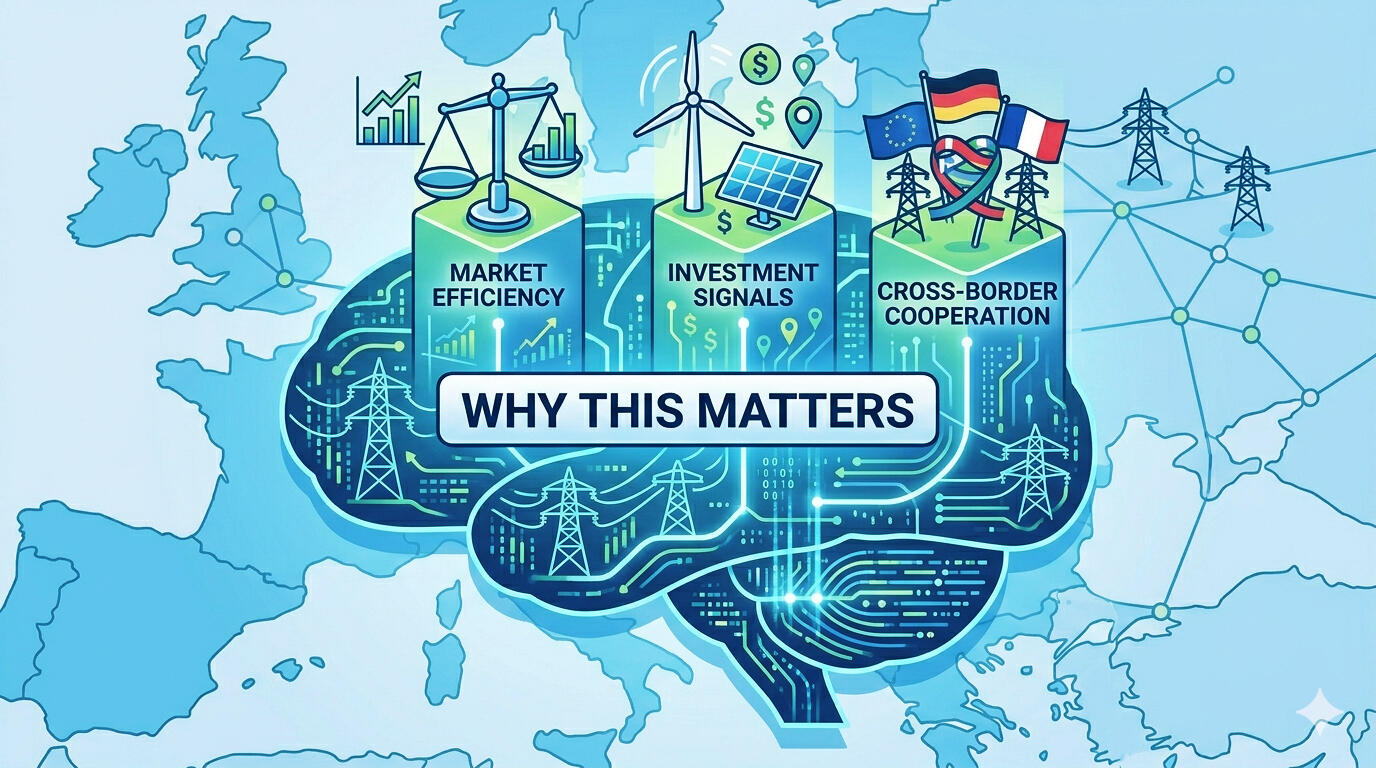
Maintains scheduled exchanges while adjusting physical flows💡 It’s less about changing who produces, and more about where balancing occurs.Why this matters
Congestion management isn’t just an operational detail it, shapes:Market efficiency
Price formation
Investment signals (where new capacity is needed)
Cross-border cooperationAs grids decarbonize and variable renewables scale, congestion is becoming structural, not exceptional.Article content
The bigger picture
Frequent redispatch and countertrading signal a deeper issue: ➡️ Transmission constraints are lagging generation buildoutWhich raises strategic questions:Should markets shift toward nodal pricing?
How do we allocate congestion costs fairly?
What’s the right balance between market design and operator intervention?Closing thought
Redispatch and countertrading are often invisible, but they are the glue holding modern electricity markets together.Understanding them is key to understanding why “market outcomes” and “physical reality” don’t always align, and how operators bridge that gap every day.
🎯 Join us at the 2nd European Cross-Border Power Trading & Grid Balancing Market 2026 conference!
📍 September 17-18, 2026 | Berlin, Germany
💥 Register Now: DOWNLOAD EVENT AGENDA
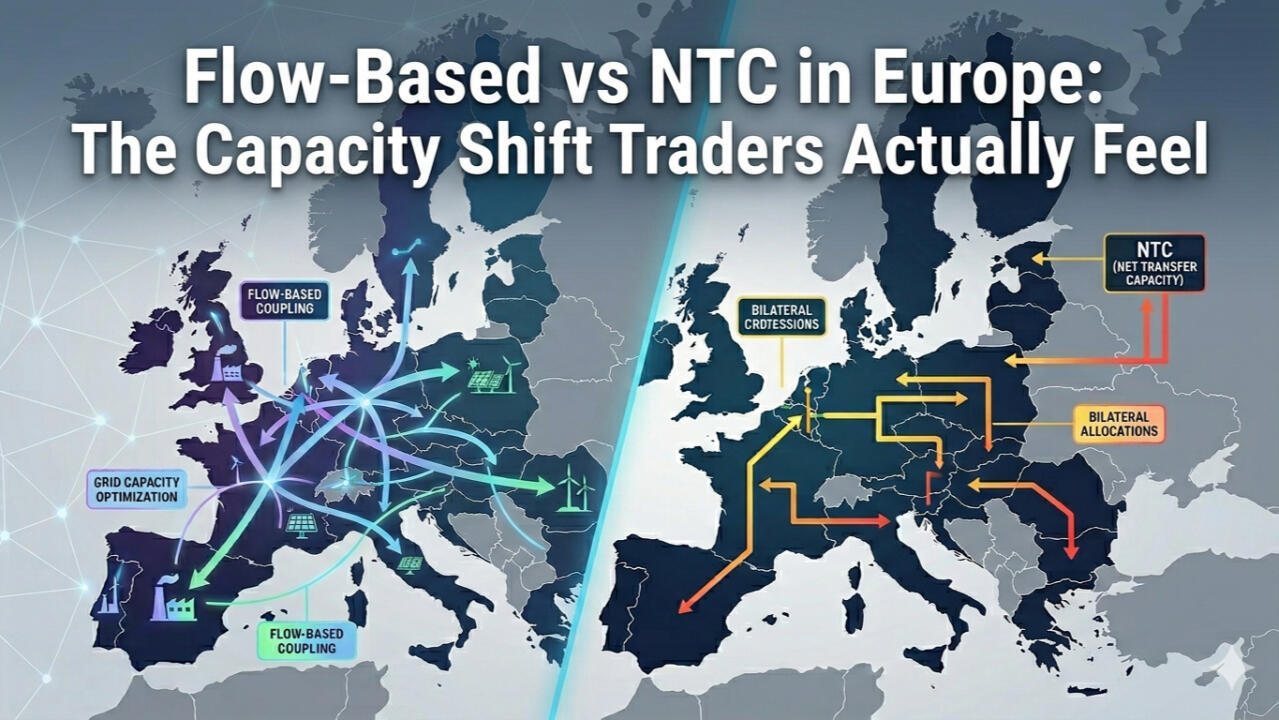
Flow-Based vs NTC in Europe: The Capacity Shift Traders Actually Feel
What changes when Europe’s power markets become network-aware and why it matters.
If you’re entering European power markets, you’ll quickly come across two key concepts: NTC (Net Transfer Capacity) and Flow-Based. They both answer the same fundamental question:How much electricity can move between countries?But in Europe, where grids are deeply interconnected, the way this question is answered has evolved significantly. And that evolution is something traders feel every day.The European Context: Why This Matters More Here
Europe isn’t a collection of isolated markets, it’s a highly meshed system.Power flowing from France to Germany might:-Physically pass through Belgium
-Impact constraints in the Netherlands
-Affect prices across multiple countries simultaneouslyThis complexity is exactly why Europe has been moving from NTC to Flow-Based, especially in the Core region (Central Western Europe and beyond).
🎯 Join us at the 2nd European Cross-Border Power Trading & Grid Balancing Market 2026 conference!
📍 September 17-18, 2026 | Berlin, Germany
💥 Register Now: DOWNLOAD EVENT AGENDA
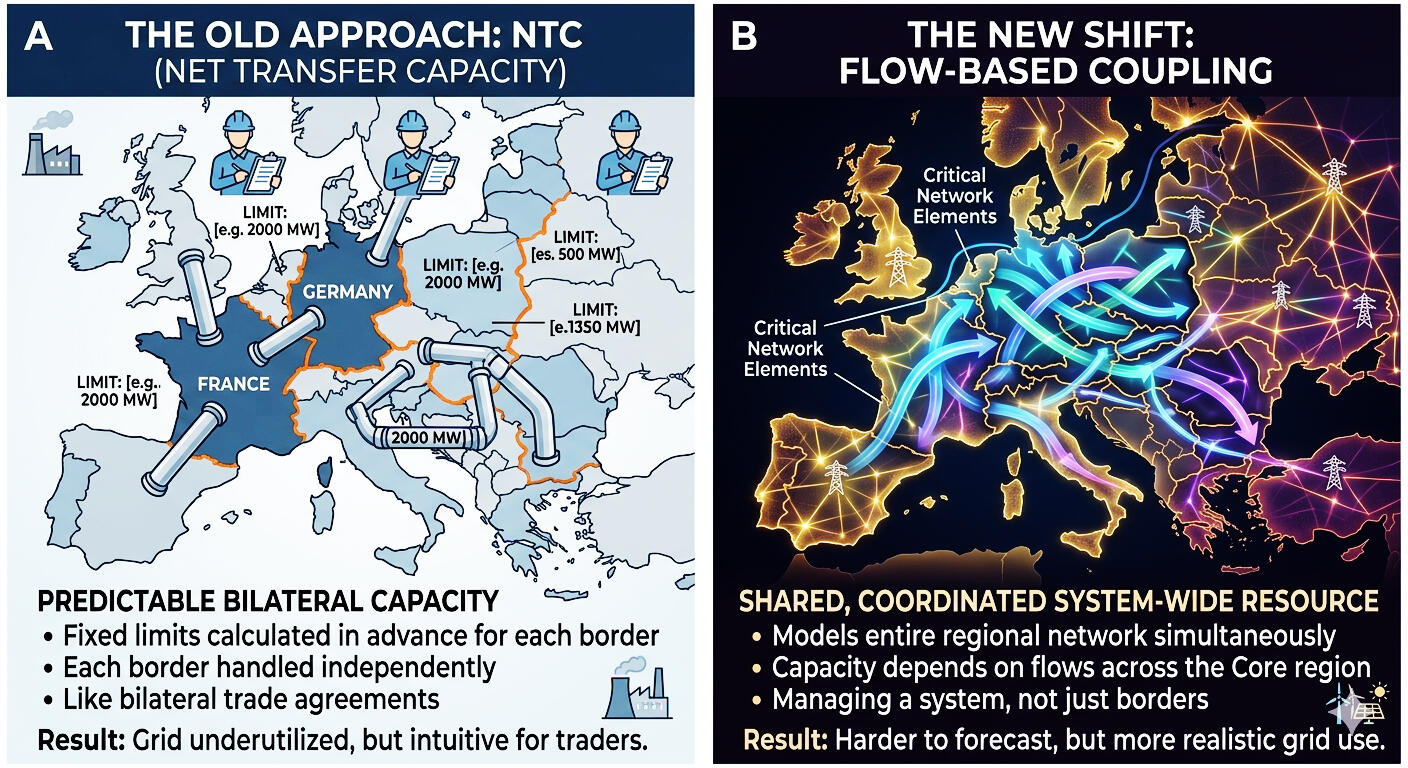
The Old Approach: NTC in European Markets
Under NTC, Europe treated borders like separate pipes: Each cross-border connection (e.g., France–Germany) had a fixed limit, capacities were calculated ahead of time and each border was handled independently.For traders, this meant: Clear, published limits between bidding zones, relatively straightforward spread trading and predictable constraints.But there was a catch:👉 These limits often underused the grid, because they didn’t reflect how electricity actually flows across multiple countries at once.The Shift to Flow-Based in EuropeFlow-Based was introduced to better reflect the physics of the European grid.Instead of assigning capacity border by border, it: models the entire regional network simultaneously, considers how one trade impacts flows across many lines and uses constraints on critical network elements (CNEs). In practice: There is no single “France–Germany capacity” anymore in the same way.
👉 Capacity becomes a shared, system-wide resource*
What European Traders Actually Experience
1. Capacity is no longer “per border”Under Flow-Based: You don’t just look at one interconnector, capacity depends on flows across the whole core region.👉 A trade between two countries might be limited by a constraint in a third country2. More realistic - but less intuitive - price formationBecause the grid is modeled more accurately: Price spreads reflect real congestion patterns, loop flows and parallel paths are implicitly accounted for👉 Prices can move in ways that feel surprising if you’re used to NTC logic.3. Non-linear and sometimes counterintuitive outcomesIn Flow-Based: Increasing demand in one zone can reduce capacity elsewhere, a trade that “should work” under NTC may not clear.👉 Traders often encounter outcomes that require deeper system understanding4. New opportunities - but also new risksThe upside: Better utilization of cross-border capacity, Occasional hidden capacity unlocked by the systemThe challenge: Harder to forecast available capacity, greater reliance on data, tools, and experience.Why Europe Made the Shift
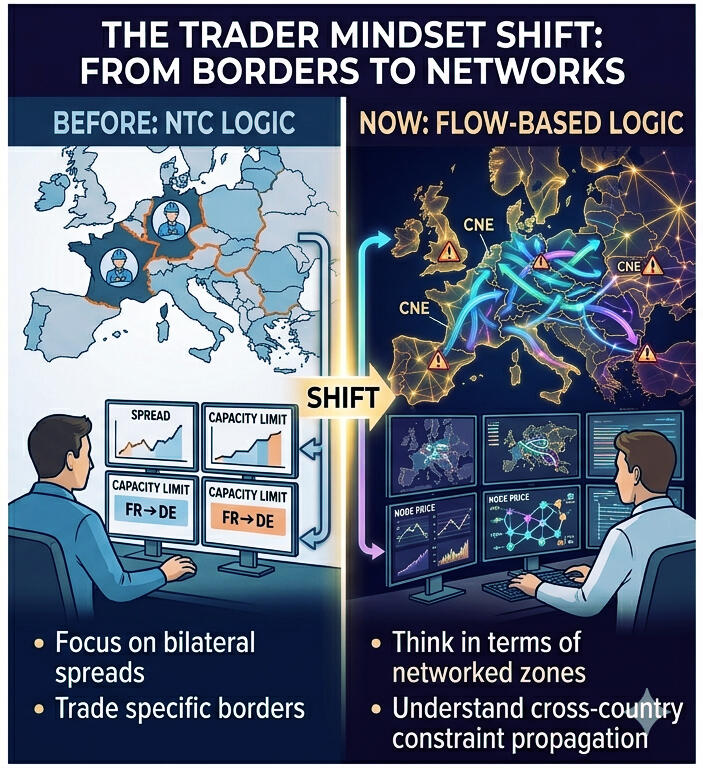
The move to Flow-Based is driven by three main goals: use the grid closer to its real limits, strengthen the single european electricity market and better reflect physical realities, even if complexity increases initiall.In Europe, the transition from NTC to Flow-Based changes how traders think:Before: Focus on bilateral spreads, trade specific borders.Now: Think in terms of zones within a network, understand how constraints propagate across countries.
Final Thoughts
Flow-Based is not just a technical upgrade, it’s a structural shift in how Europe allocates capacity. It can feel less predictable at first, especially if you’re used to clear border limits. But over time, it provides a more accurate picture of how electricity actually flows across the continent.In Europe, NTC simplified reality. Flow-Based embraces it. For anyone entering the market, understanding this shift is key to making sense of prices, risks, and opportunities.
🎯 Join us at the 2nd European Cross-Border Power Trading & Grid Balancing Market 2026 conference!
📍 September 17-18, 2026 | Berlin, Germany
💥 Register Now: DOWNLOAD EVENT AGENDA
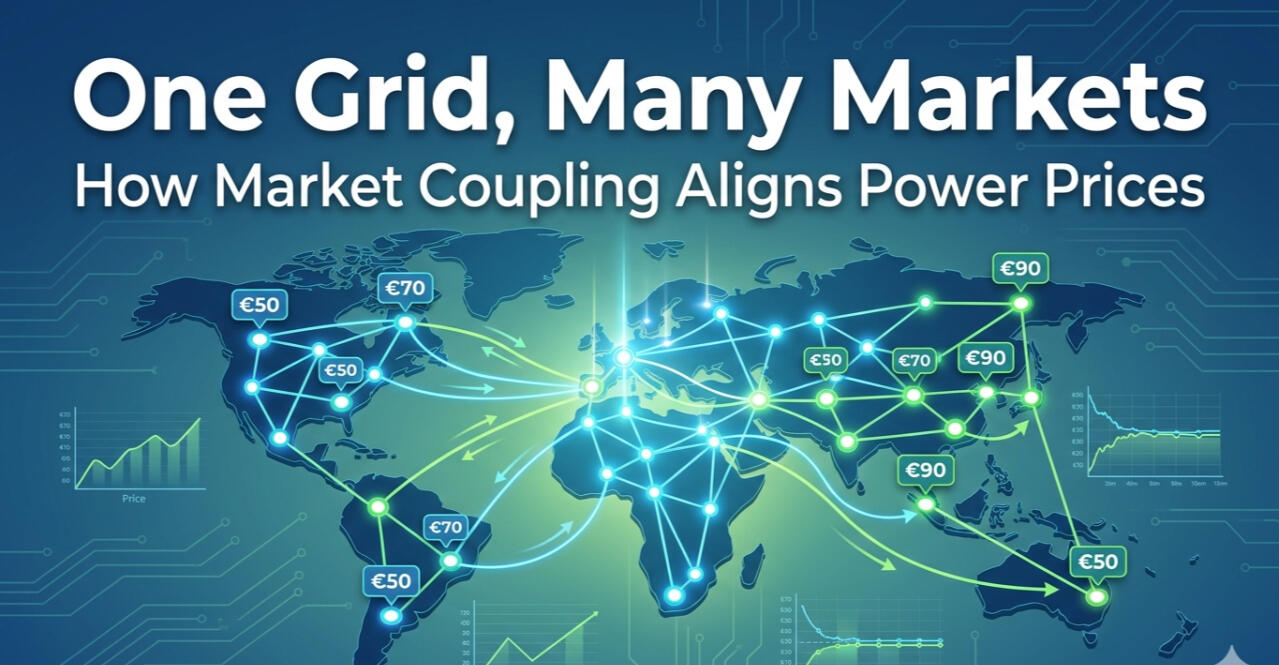
One Grid, Many Markets: How Market Coupling Aligns Power Prices
From Day-Ahead to Intraday: What Actually Drives Cross-Border Flows
Why Do Power Prices Differ Across Borders?
Even in interconnected regions, electricity prices don’t always match. Why? Because without coordination:One region may have surplus (low prices)
Another may face shortage (high prices)
And limited transmission prevents balancingThis leads to inefficiencies—cheap power stays unused while expensive power is still produced elsewhere. Market coupling exists to fix exactly this problem.What is Market Coupling (In Plain Terms)?
Market coupling connects electricity markets so they clear together instead of separately. Instead of each region deciding prices on its own, it becomes one coordinated outcome across regionsThe system simultaneously decides:Who generates electricity
Where it flows
What price each region seesAll while respecting grid limits.
🎯 Join us at the 2nd European Cross-Border Power Trading & Grid Balancing Market 2026 conference!
📍 September 17-18, 2026 | Berlin, Germany
💥 Register Now: DOWNLOAD EVENT AGENDA
The Core Idea (No Math Needed)
At its simplest, market coupling ensures: Electricity flows from where it’s cheapest → to where it’s needed most. When this happens: costs go down, prices start aligning and cross-border capacity is used efficiently.
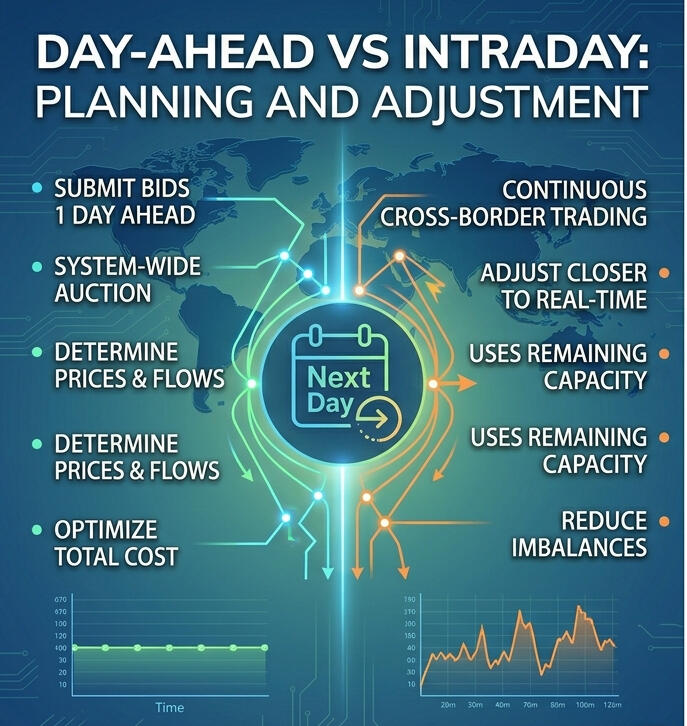
Day-Ahead Market Coupling: Participants submit bids for the next day, a central algorithm clears all regions together and prices and flows are determined in one go.What you see: Power flows from low-price to high-price regions and prices converge when capacity allows. If transmission is limited, prices still differ, but less than before.Intraday Market Coupling: Reality doesn’t follow forecasts. Things change: Wind drops, demand spikes and plants trip. That’s where intraday comes in. It enables continuous cross-border trading, lets participants adjust closer to real time and uses any remaining transmission capacity.Why it matters: Reduces imbalances, avoids expensive last-minute fixes and adds flexibility to the system.What’s Really Being Coordinated?
Across both markets, three things move together:1. Prices: Reflect real-time supply-demand conditions2. Flows: Electricity moves across borders3. Capacity: Transmission limits are respectedThis coordination is what turns separate markets into one system.What Happens Without Coupling?
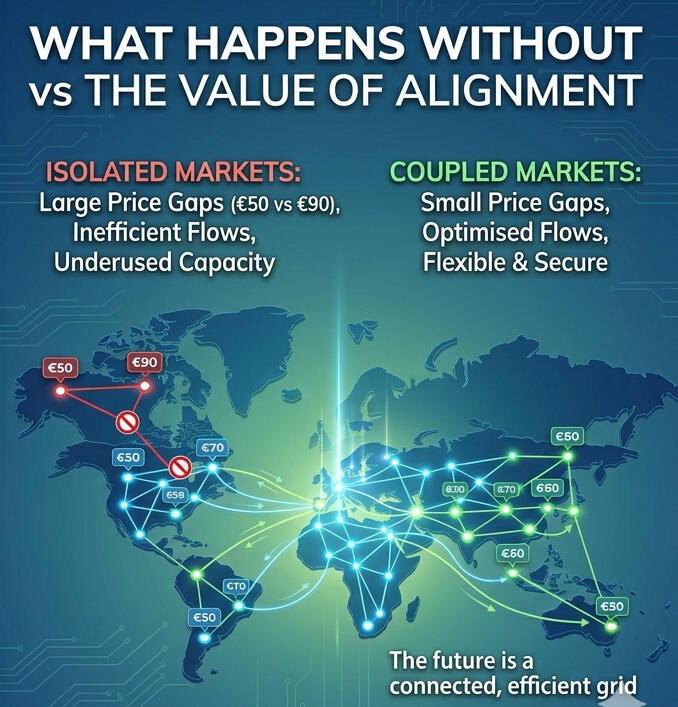
Think of three scenarios:No coupling → Large price differences, inefficiency
Partial coupling (limited capacity) → Some convergence
Strong coupling (enough capacity) → Prices align, flows optimizeThat middle case is where most real-world systems operate today.Final Take
Market coupling is not about complexity, it’s about coordination at scale.It ensures: Power flows where it creates the most value, prices reflect system-wide realities and cross-border infrastructure is fully utilized.In short: Coupled markets are more efficient, more resilient, and better suited for a renewable-heavy future.
🎯 Join us at the 2nd European Cross-Border Power Trading & Grid Balancing Market 2026 conference!
📍 September 17-18, 2026 | Berlin, Germany
💥 Register Now: DOWNLOAD EVENT AGENDA
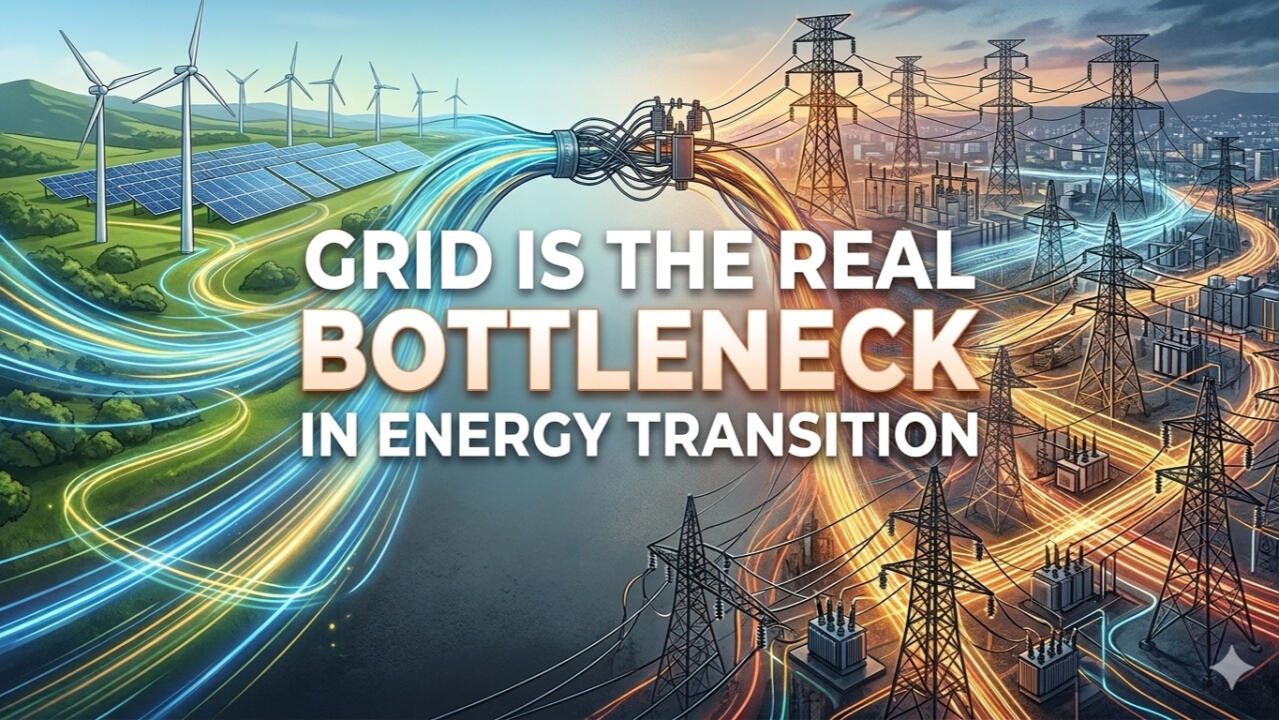
Grid Is the Real Bottleneck in Energy Transition
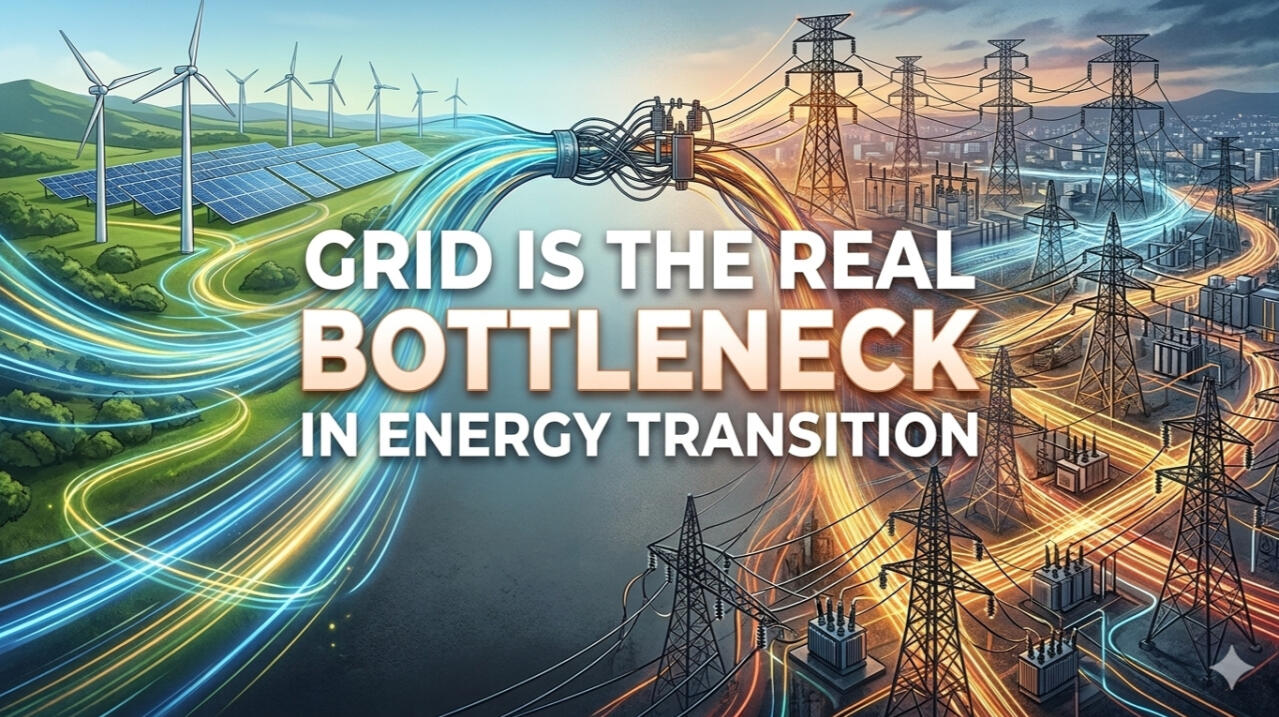
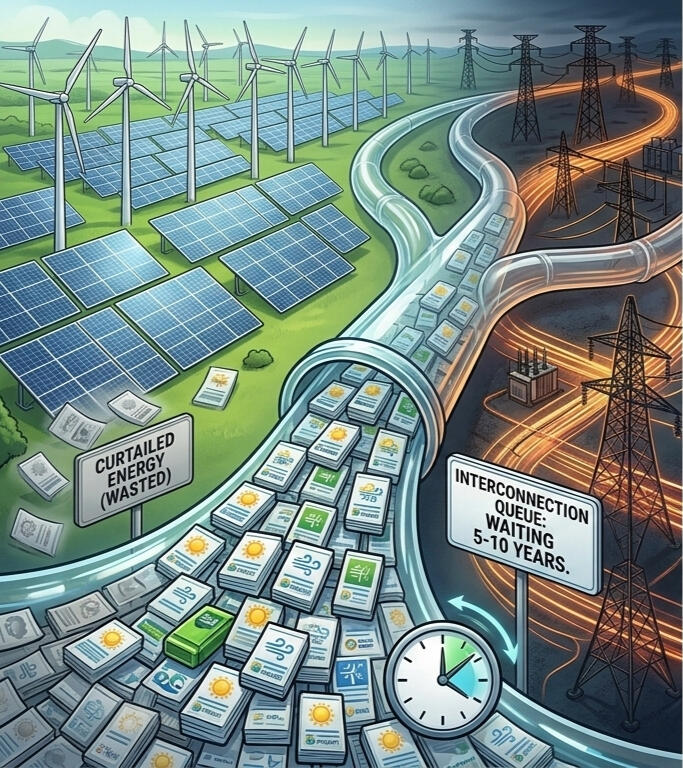
For years, the biggest challenge in the energy transition was building enough renewable energy capacity. Today, that problem is rapidly disappearing.Solar and wind are now the cheapest sources of electricity in many regions, and investment in renewable projects continues to accelerate. Yet across the world, thousands of clean energy projects remain stuck in queues, curtailed, or delayed. The reason is increasingly clear.The grid cannot keep up. Transmission infrastructure, the backbone of the power system, has become one of the biggest bottlenecks in the global energy transition.The Growing Mismatch Between Generation and Grid Capacity
Renewable energy projects are often built where resources are strongest, not where electricity demand is highest.Solar farms are built in sunny deserts and open land.
Wind farms are located offshore or in windy rural areas.But electricity demand tends to be concentrated in urban and industrial centers. This creates a fundamental challenge: electricity must travel hundreds or even thousands of kilometers to reach consumers. Without sufficient transmission capacity, even the most efficient renewable projects cannot deliver their power to the grid.
Transmission Congestion: When the Grid Gets Full
One of the clearest signs of grid bottlenecks is transmission congestion. Congestion occurs when electricity flows reach the maximum capacity of transmission lines. When this happens, grid operators must limit generation to maintain system stability.The result?Renewable plants are forced to reduce output
Electricity prices can spike or collapse depending on location
Clean energy gets curtailed despite strong demandIn some regions, congestion is already causing billions of dollars in lost renewable energy every year.
🎯 Join us at the 2nd European Cross-Border Power Trading & Grid Balancing Market 2026 conference!
📍 September 17-18, 2026 | Berlin, Germany
💥 Register Now: DOWNLOAD EVENT AGENDA
Renewable Curtailment: Clean Energy That Never Gets Used
Curtailment refers to situations where renewable power plants are instructed to shut down or reduce generation, even when wind or solar resources are available.This usually happens when: the grid cannot transport the electricity, supply exceeds local demand, or system stability must be maintained.While curtailment is sometimes necessary, rising levels indicate structural grid limitations. Ironically, this means that clean electricity is being wasted while fossil plants continue operating elsewhere in the system.The Interconnection Queue Problem
Another major bottleneck lies in the interconnection process — the procedure that allows new power plants to connect to the grid. In many electricity markets, the number of proposed renewable projects has grown dramatically.However, grid operators must study each project to ensure it does not compromise system reliability. This has created massive queues. In some regions:thousands of gigawatts of projects are waiting for approval
developers face years-long delays before construction can begin
many projects ultimately withdraw due to uncertainty and costsIn other words, the energy transition is increasingly limited not by technology or investment but by administrative and infrastructure constraintsPossible Solutions
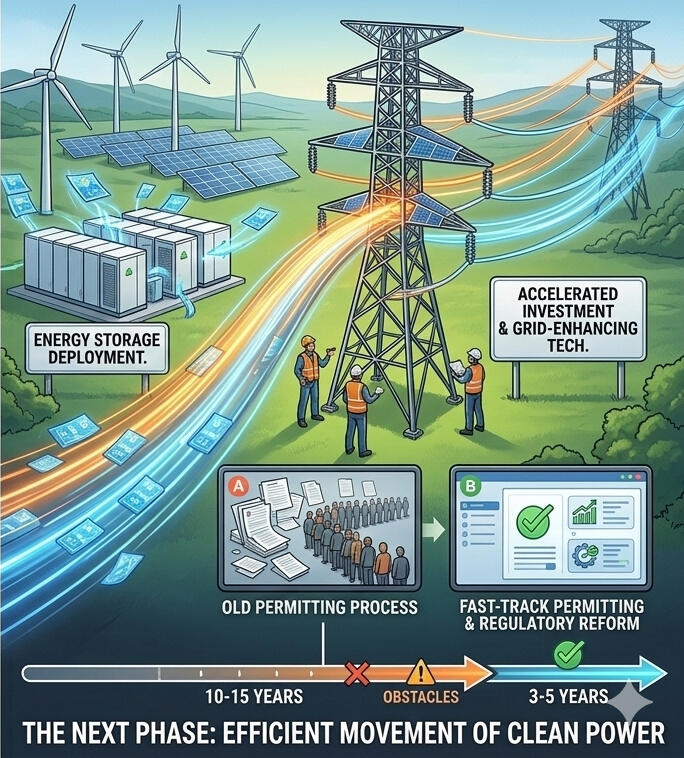
Addressing the grid bottleneck will require a combination of strategies:1. Accelerated transmission investment Large-scale grid expansion and modernization will be necessary.2. Grid-enhancing technologies Dynamic line ratings, advanced conductors, and digital monitoring can increase capacity on existing lines.3. Energy storage deployment Battery storage can absorb excess generation and release it during peak demand.4. Smarter market design Better price signals can incentivize generation where the grid has capacity.**5. Faster permitting processes **Regulatory reform could significantly reduce project timelines.The Next Phase of the Energy Transition
The first phase of the clean energy transition was about making renewable power cheap. That phase has largely succeeded.The next phase is about moving electricity efficiently across the system. And that challenge will define the next decade of energy infrastructure investment. Because increasingly, the future of clean energy depends not just on how much power we generate but on how effectively we move it.
🎯 Join us at the 2nd European Cross-Border Power Trading & Grid Balancing Market 2026 conference!
📍 September 17-18, 2026 | Berlin, Germany
💥 Register Now: DOWNLOAD EVENT AGENDA
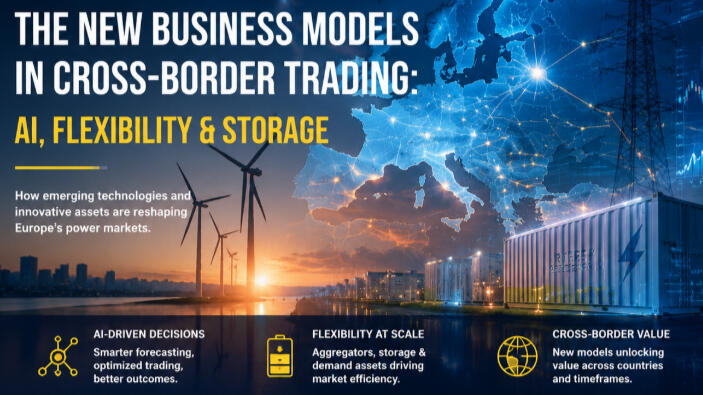
The New Business Models in Cross‑Border Trading: AI, Flexibility & Storage
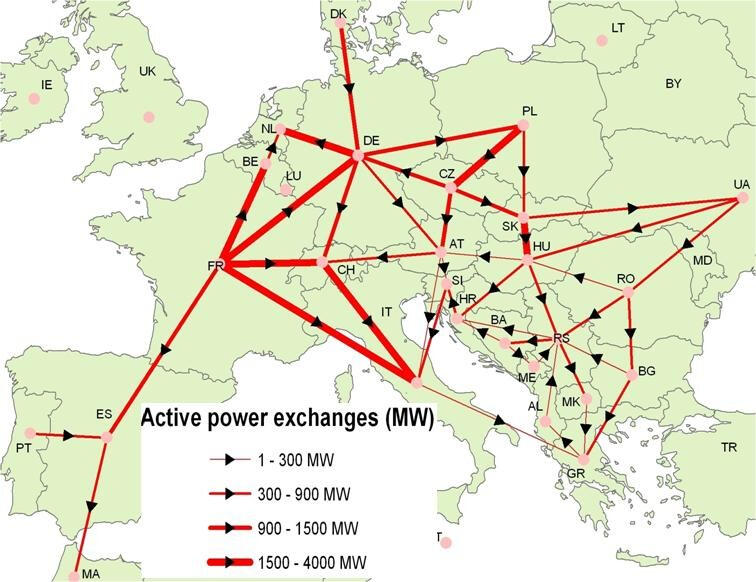
Market Spotlight: Europe Faces Surging Winter Power PricesEurope’s electricity markets are undergoing a transformative phase, driven by cross-border trading, AI-powered optimisation, and flexible storage assets. Two major developments highlight this trend:1. Winter Power Price Surge
European wholesale electricity winter contracts have risen sharply due to gas supply uncertainty, low hydropower reserves, and increased renewable penetration. This volatility creates strategic opportunities for flexibility assets and battery energy storage systems (BESS) to participate in intraday markets and cross-border trading, unlocking new revenue streams for utilities and aggregators.2. EU Approves €2.9B Funding to Boost Cross-Border Grid Capacity
The European Commission has approved €2.9 billion under the Connecting Europe Facility (CEF)for 11 energy infrastructure projects, including key cross-border electricity interconnectors. This initiative is designed to:Enhance market integration across EU countries
Improve security of electricity supply
Accelerate Europe’s clean energy transitionCombined, these developments highlight the strategic importance of AI-driven optimisation, flexible storage, and new cross-border trading models in shaping the future of European energy markets.
🎯 Join us at the 2nd European Cross-Border Power Trading & Grid Balancing Market 2026 conference!
📍 September 17-18, 2026 | Berlin, Germany
💥 Register Now: DOWNLOAD EVENT AGENDA
Why These Trends Matter for New Business Models
1. Capturing Value Amid Price Volatility
Battery storage and flexibility assets can arbitrage across markets as interconnectors reduce bottlenecks.
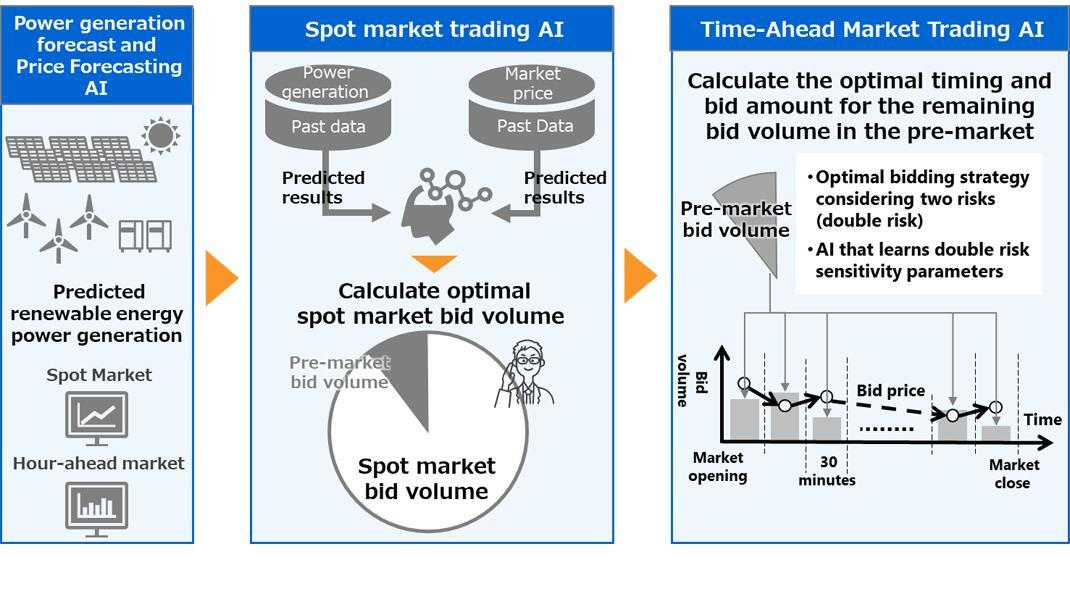
Intraday and balancing markets become more profitable with widening price spreads.2. AI-Enhanced Market Optimisation
Real-time AI algorithms optimise dispatch for BESS, industrial loads, and VPPs.
Predictive analytics improve intraday bidding, hedging, and cross-border trading strategies.
3. Flexibility as a Tradable Asset
Industrial assets like steel, cement, and data centres participate in balancing markets.
VPPs aggregate distributed energy and flexibility to deliver grid services and trading revenues.Storage: A Strategic Hedge for Market Participants
With rising winter prices and EU cross-border infrastructure investment, storage and flexibility are no longer optional — they are strategic assets that enable:Capturing price spreads across interconnected markets
Providing ancillary services and balancing capacity
Enhancing grid reliability and trading efficiency
Key Takeaway
The convergence of market volatility, EU €2.9B cross-border grid investment, and AI-enabled storage and flexibility models is reshaping European electricity markets. Forward-thinking utilities, aggregators, and industrial participants that adopt AI optimisation, BESS deployment, and cross-border trading strategies will unlock resilience, profitability, and a competitive edge in the new era of European energy trading.
🎯 Join us at the 2nd European Cross-Border Power Trading & Grid Balancing Market 2026 conference!
📍 September 17-18, 2026 | Berlin, Germany
💥 Register Now: DOWNLOAD EVENT AGENDA
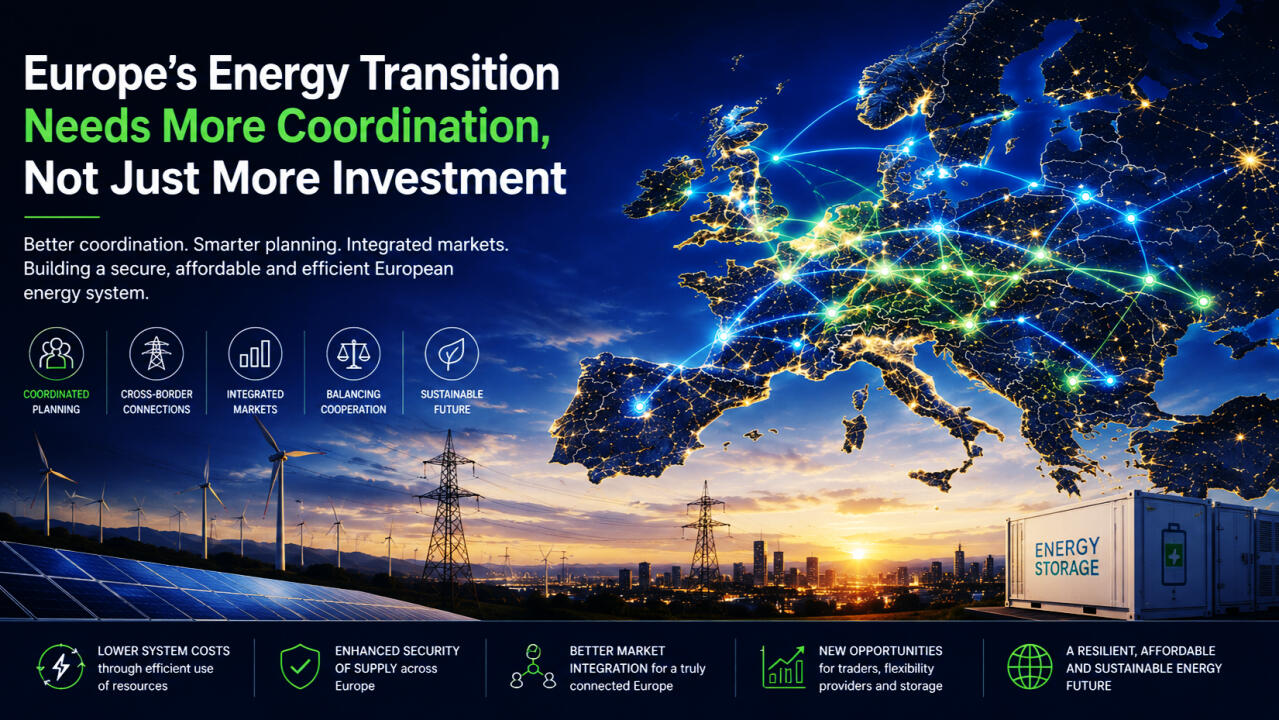
Europe’s Energy Transition Needs More Coordination, Not Just More Investment
As renewable generation expands, electrification accelerates, and cross-border power flows become increasingly important, fragmented planning across national markets is creating inefficiencies that drive up costs, slow infrastructure deployment, and limit the full value of market integration.
🎯 Join us at the 2nd European Cross-Border Power Trading & Grid Balancing Market 2026 conference!
📍 September 17-18, 2026 | Berlin, Germany
💥 Register Now: DOWNLOAD EVENT AGENDA
The event will bring together TSOs, regulators, utilities, power exchanges, traders, aggregators, flexibility providers, storage players, and technology leaders to discuss market coupling, balancing markets, congestion management, capacity allocation, cross-border flexibility, and the future of Europe’s interconnected power markets.Today, electricity markets are becoming more integrated, yet planning decisions for generation, transmission, storage, and demand-side resources remain largely national. This disconnect often leads to duplicated investments, congestion bottlenecks, inefficient use of infrastructure, and missed opportunities to optimize resources across borders.

As balancing markets become increasingly interconnected and cross-border trading volumes continue to grow, effective coordination between TSOs and market participants will play a critical role in maintaining system stability while maximizing the value of Europe’s renewable resources. Improved access to balancing capacity across borders can reduce system costs, enhance security of supply, and create new opportunities for traders, flexibility providers, aggregators, and storage operators.For market participants, these developments have direct implications for interconnector investments, congestion management strategies, capacity allocation methodologies, balancing market design, and the economics of cross-border trading.The policy direction is clear : Europe’s energy future depends not only on expanding clean energy capacity but also on improving how the system is planned, managed, and integrated. Coordinated grid development, transparent data sharing, harmonized market frameworks, and cross-border flexibility mechanisms will be critical to building a secure, affordable, and resilient energy system.As Europe moves toward deeper market integration, discussions around coordinated grid planning, market coupling, balancing cooperation, congestion management, flexibility markets, and cross-border trading frameworks will become increasingly important. Success will depend not only on investment in infrastructure, but also on the ability of European markets to coordinate more effectively across borders and operate as a truly interconnected energy system.
🎯 Join us at the 2nd European Cross-Border Power Trading & Grid Balancing Market 2026 conference!
📍 September 17-18, 2026 | Berlin, Germany
💥 Register Now: DOWNLOAD EVENT AGENDA
A dedicated platform focused on market coupling, balancing markets, flexibility, energy storage, congestion management, capacity allocation, and the future of European cross-border power trading.